For the first time in two decades, exports from an Asian country to the United States have exceeded the total export value to China. In addition, the U.S. trade deficit has declined at its fastest rate since 2009, driven by reduced dependence on China.
According to CNN, for the past two decades, the United States has imported more from China than from any other economy. However, that has now changed.
Data from the U.S. Department of Commerce shows that Mexico has overtaken China to become the largest source of imports for the world’s leading economy.
In 2023, Mexico exported goods worth a total of 475.6 billion USD to the United States, up 5% from the previous year. Meanwhile, China’s total exports to the U.S. reached only 427.2 billion USD, down 20% compared to 2022.
Thanks to reduced dependence on China, the U.S. total trade deficit—the measure of the balance between imports and exports—fell by 19% in 2023 to 773.4 billion USD. This marks the sharpest decline since 2009.
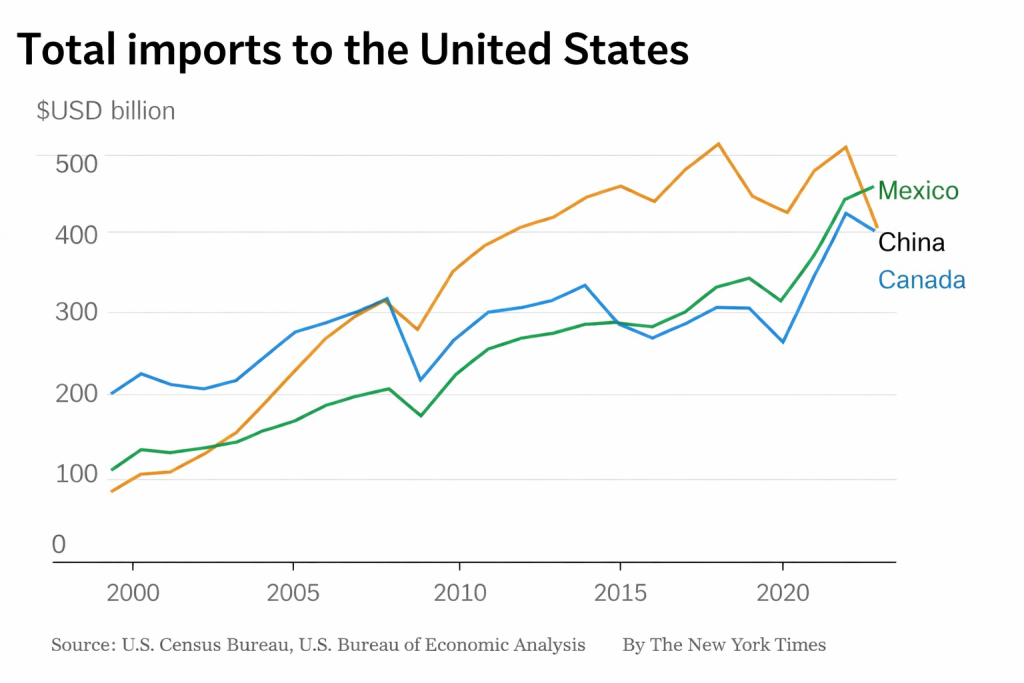
Senior expert Brad Setser of the U.S. Council on Foreign Relations (CFR) stated that the tariff barriers imposed by former U.S. President Donald Trump on Chinese imports have been a key factor affecting the trade deficit described above.
In addition, economist Matthew Martin of Oxford Economics noted that the depreciation of the U.S. dollar has made American exports cheaper, thereby boosting sales and helping to reduce the trade deficit.
According to CNN, American consumers have reduced their purchases of Chinese imported goods such as electronics, as prices are no longer as cheap as before. In contrast, spending has shifted toward services such as travel and entertainment, which have become more prominent in U.S. consumption patterns.
Times have changed
The New York Times (NYT) reported that during the pandemic, when container shipping costs to China increased 20-fold, Marco Villarreal spotted an opportunity.
In 2021, Villarreal resigned as CEO of Caterpillar in Mexico and began seeking companies looking to relocate production from China to the United States’ neighboring country.
A client in Hisun, China, specializing in all-terrain vehicles, hired Villarreal to establish a $152 million factory in Saltillo, Mexico.
This was not Villarreal’s only client, as the expert said many businesses are looking to relocate factories due to concerns over U.S.–China trade tensions.
“Everyone is flocking to Mexico,” Villarreal acknowledged.
According to the NYT, the U.S. trade deficit with China has declined significantly as consumers shift toward imported products such as auto parts, footwear, toys, and raw materials from Mexico, Europe, South Korea, India, and Canada.
During the pandemic, Americans were stuck at home and went on a shopping spree online, buying cheap imported products from China such as laptops, toys, COVID-19 test kits, furniture, sports equipment, and more.