Professor Klaus Schwab, Chairman of the World Economic Forum (WEF), has stated that over the next few decades, Vietnam will experience strong economic growth and play a significant role in the global economy.
On the morning of October 6, the Ho Chi Minh City Department of Foreign Affairs and Hoa Sen University jointly organized an inspirational talk for young people titled “Knowledge Economy – The Foundation for a Prosperous Future and Youth Action.”
At this event, Professor Klaus Schwab, Chairman of the World Economic Forum (WEF), said that within the next 20–30 years, Vietnam will become one of the top 40 largest economies in the world.
The main driving force behind this development is continuous innovation and the entrepreneurial spirit of the younger generation. In Vietnam, especially in Ho Chi Minh City, there is a community of highly enthusiastic young leaders who are ready to create new breakthroughs.
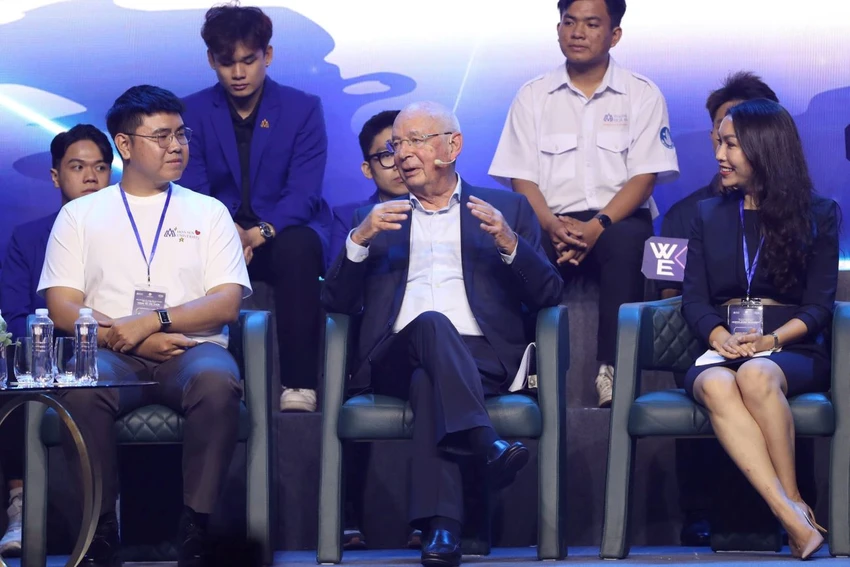
“The world is transitioning from the industrial era to the intelligent era, where the convergence of physical, digital, and biological domains—driven by advances in artificial intelligence (AI)—will revolutionize the way we live, work, and communicate.
In the intelligent era, technology provides us with powerful tools to address global challenges.
However, to fully harness this potential, we need visionary leaders who possess deep systems understanding and the ability to turn creative ideas into concrete actions.
Effective leadership will be the decisive factor in guiding and addressing the complex challenges of this era,” Mr. Klaus Schwab stated.
Speaking at the event, Mr. Phan Van Mai, Chairman of the Ho Chi Minh City People’s Committee, said that the world is changing rapidly, and globalization as well as the Fourth Industrial Revolution are becoming increasingly powerful. This requires countries and localities to continuously develop, cooperate, and move in line with global trends.
Ho Chi Minh City, a pioneer in innovation, has been actively transforming its growth model toward a green economy, digital economy, and sustainable development.
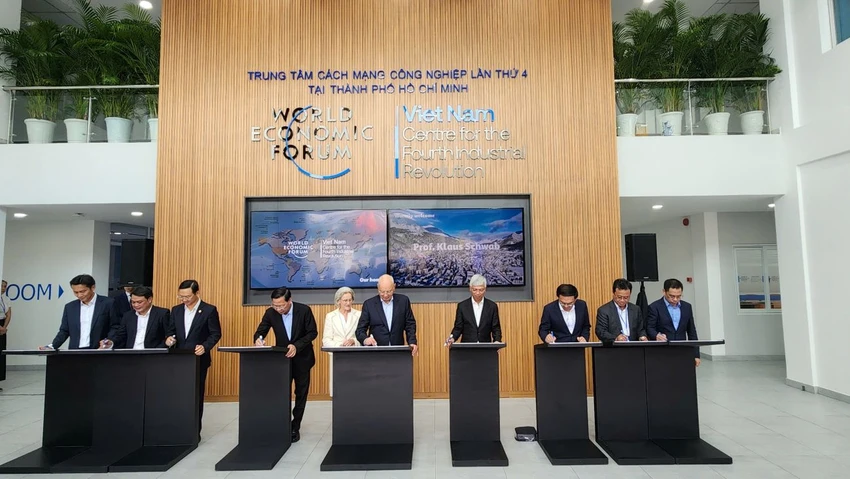
“The shift from a traditional economy to a knowledge-based economy requires a comprehensive restructuring of the entire economy, with breakthrough development in three strategic pillars: infrastructure, institutions, and human resources. These must be implemented not only simultaneously but also in a balanced and well-coordinated manner.
Among them, human capital will be the key objective and the main driving force for promoting the development of the knowledge economy.
To turn potential into reality, we need breakthrough solutions in education and training, closely linked to the practical needs of the city’s economy.
We need a young generation that is not only fully equipped with professional knowledge but also trained in creativity, critical thinking, and the ability to quickly adapt to new technologies,” Mr. Phan Van Mai said.
Source: Phuong Minh, Phap Luat Ho Chi Minh City Newspaper.